

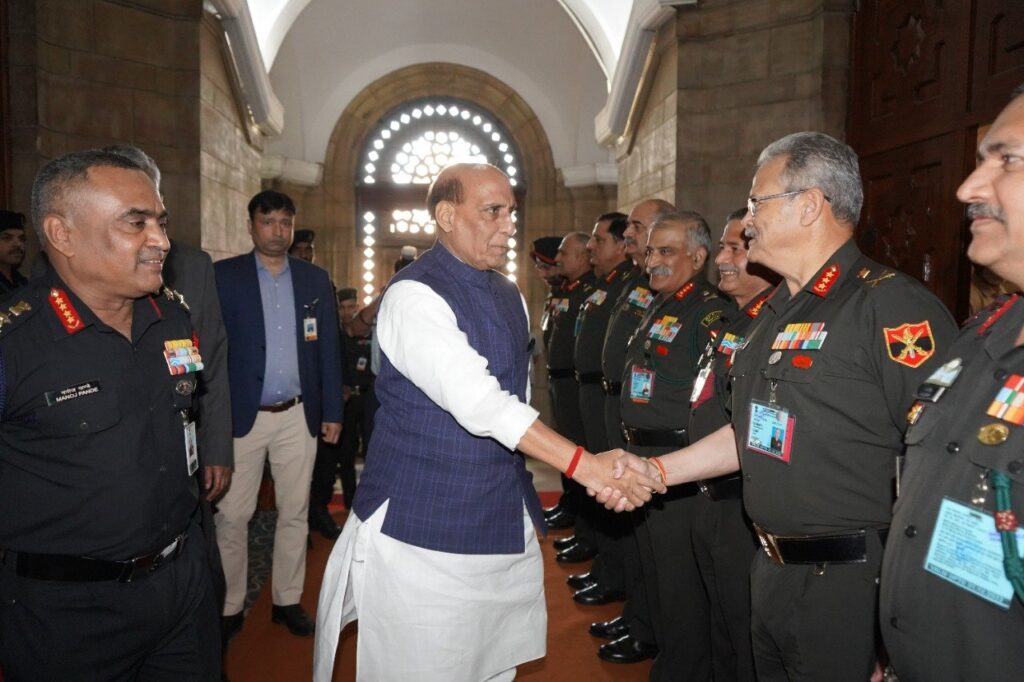
Rajnath Singh Warns of Full-Scale Retaliation, Says Operation Sindoor Just a ‘Trailer’
India’s Firm Military Stand: What Rajnath Singh Said in Bhuj
Bhuj, Gujarat – May 17:
Rajnath Singh Warns of Full-Scale Retaliation, Says Operation Sindoor Just a ‘Trailer’
Bhuj, Gujarat – May 17:
In a stern message to Pakistan and a reaffirmation of India’s uncompromising national security stance, Defence Minister Rajnath Singh declared that the recent military offensive, Operation Sindoor, is far from over. Addressing the armed forces at the strategically significant Bhuj Airbase in Gujarat’s Kutch region, Singh described the operation as merely a “trailer” and warned of a stronger response if provoked again.
“The operation isn’t over yet. What you’ve seen so far is just a trailer,” Singh remarked, indicating that India holds the capacity and willingness to escalate operations further if necessary. Emphasizing a zero-tolerance policy against terrorism, he added, “New India does not tolerate terrorism—eliminating it is now our standard approach.”
His remarks come at a time of heightened tension between the two nuclear-armed neighbours . The four-day confrontation saw increased military activity, especially targeting sensitive defence installations such as the Bhuj airbase. Singh underlined that Bhuj was one of the primary targets of Pakistan during the standoff, but Indian forces successfully safeguarded national interests.
He issued a clear warning: “If Pakistan maintains peace, so will we. But any disturbance will be met with the harshest punishment.” This signals a clear shift from previous strategies of strategic restraint to more proactive and assertive defence measures under the current Indian government.
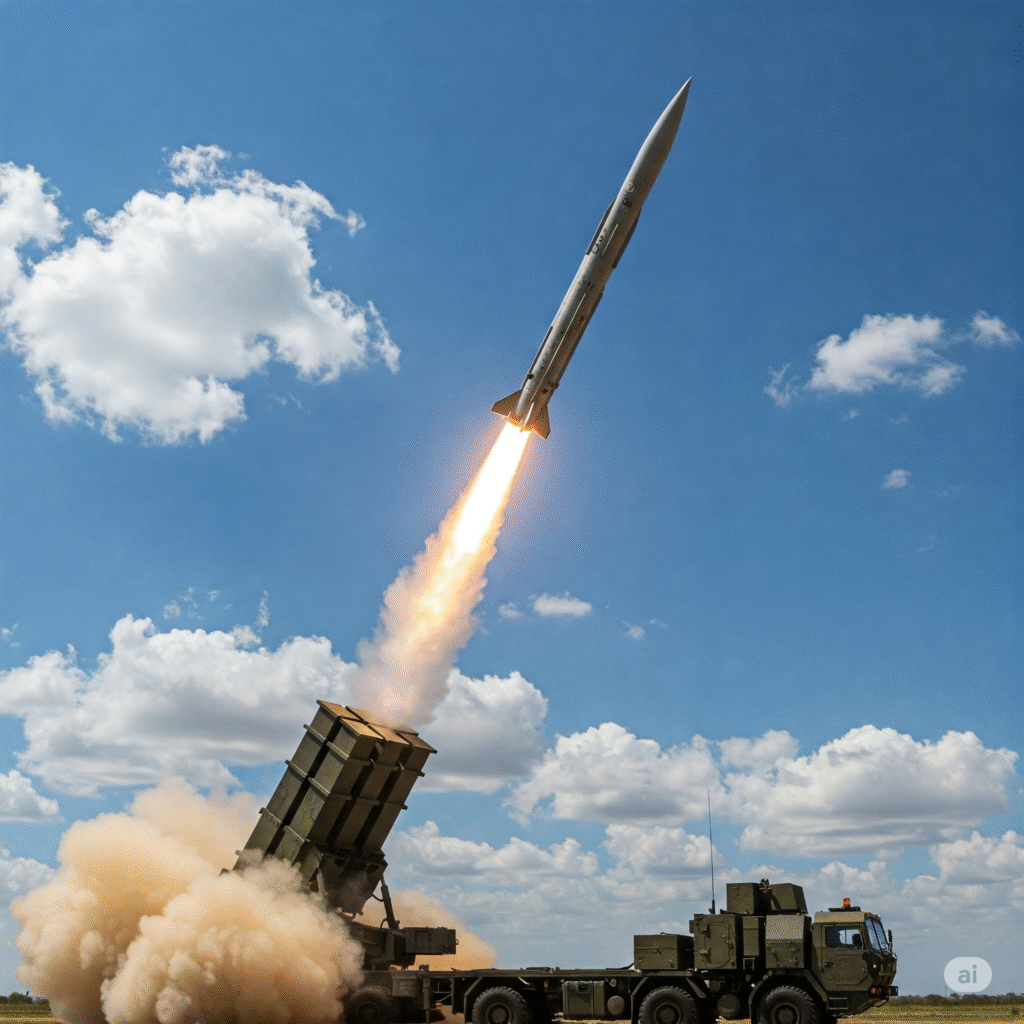
Singh praised the Indian Air Force (IAF) for its crucial role in Operation Sindoor, noting that it not only led the offensive but also showcased India’s technological and tactical superiority. According to him, the IAF used Made in India BrahMos supersonic missiles during the operation, describing them as precision weapons that “showed Pakistan the light of day in the darkness of night.”
He went on to highlight how Indian fighter jets managed to destroy enemy infrastructure without violating international borders. “Our jets can now strike every corner of Pakistan without even crossing the border,” he stated. This remark underscores India’s growing reliance on long-range, high-precision weaponry and its increasing focus on indigenous defence capabilities.
In addition to military matters, Singh used the occasion to make a strong diplomatic point. He urged the International Monetary Fund (IMF) to reassess its recent $1 billion aid package to Pakistan. He alleged that such financial support could indirectly fund terrorism, accusing the Pakistani government of using international assistance to rebuild terror hubs.
“Supporting Pakistan financially is equivalent to funding terrorism,” Singh said, referencing reports that Islamabad has allocated funds for reviving Lashkar-e-Taiba and Jaish-e-Mohammed’s infrastructure in Muridke and Bahawalpur—areas known for housing some of the most dangerous terror outfits operating in South Asia.
The Defence Minister’s speech comes at a crucial time, reinforcing India’s evolving national security doctrine that no longer hinges solely on defensive postures. His message is clear: India is prepared for a calibrated yet powerful response to any threat against its sovereignty.
This assertiveness is also part of a broader narrative being promoted by the Indian government—that of a “New India” capable of standing firm on the global stage and taking swift action against any adversary, whether militarily, diplomatically, or economically.
Singh’s statements at Bhuj resonate not just with military personnel but also with a larger national sentiment demanding accountability and security. As India continues to build and modernize its defence infrastructure, the tone set by leaders like Rajnath Singh reflects a paradigm shift in how the nation approaches both terrorism and traditional conflict.
With Operation Sindoor still “not over,” as Singh emphasized, it remains to be seen how regional dynamics will evolve in the coming weeks. However, one thing is clear—India has sent a strong message, and it’s ready to act decisively if challenged again.
Image Credit: ANI News
Source: Times News Network